


By Lucy Kisielewska-Harris
Rowing is not just a sport which can bring challenges, medals and personal bests it's a sport that can provide a sense of belonging, create meaningful connections and offer a safe space for people to better understand themselves, what drives them and understand their teammates. But what happens when the pressure to perform begins to take away the very thing that made us fall in love with rowing in the first place?
I recently spoke with Claire Burley, a full-time rower based in Hong Kong and the founder of Attention Go!, a platform created to encourage conversations around neurodiversity, mental wellbeing and the positive impact of sport.
Our conversation explored Claire's personal journey, her experiences as an athlete with ADHD, and her vision for making sport a more inclusive and supportive environment for everyone. What makes Claire's story remarkable is that although she is a professional athlete, she is also trying to change the stigma on neurodiversity within sport.
The story behind Attention Go!
Claire started 'Attention Go!' to help raise awareness of neurodiversity and create a community where people can learn, connect and feel understood.
Having lived in both the UK and Hong Kong, Claire has experienced different environments and perspectives. She returned to Hong Kong to pursue rowing full-time, but she also wanted to use the opportunity to start conversations around neurodiversity and the ways in which people experience the world differently.
Claire received her ADHD diagnosis relatively recently. Before understanding more about how her brain worked, she had found comfort and security in sport. This personal experience helped shape her vision for Attention Go: to share the benefits that sport can bring, while encouraging greater understanding of the challenges that some people face.
The aim is not only to support neurodivergent people, but also to help those who may know very little about neurodiversity understand it better. By creating a safe space for discussion and education, Claire hopes to build bridges between people and challenge misconceptions.
Sport as a source of safety and community
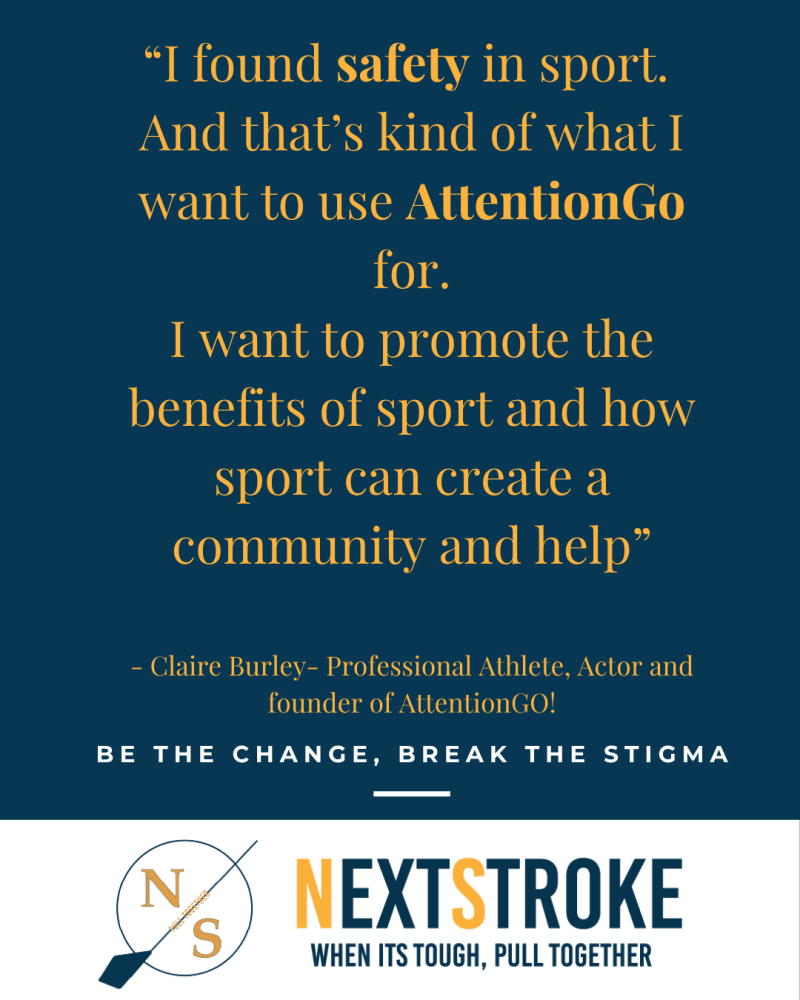
One of the strongest themes throughout our conversation was the importance of finding safety in sport.
For Claire, the repetitive nature of rowing and the community around it have provided a sense of stability and belonging. Sport can give people structure and routine, but it can also offer friendships, shared experiences and a place where they feel part of something bigger.
However, Claire's experiences have also shown her that sport is not always a positive environment. While it can provide enormous benefits, the pressure to perform can sometimes overshadow enjoyment and wellbeing.
We discussed how important it is to create sporting environments where people feel supported, regardless of their ability, background or ambitions. Whether someone participates for fun, to improve their fitness or to compete at an elite level, they should be able to enjoy the experience without feeling that their worth depends entirely on their performance.
Understanding neurodiversity in sport
Our conversation also touched on the challenges neurodivergent athletes can face when their needs are not fully understood.
Claire spoke about the importance of recognising that people think, learn and respond differently. Traditional approaches to coaching can sometimes assume that one training programme or method will work for everyone. In reality, athletes may need different approaches to help them thrive.
Communication can be another challenge, particularly when language barriers exist alongside a lack of understanding about mental health or neurodiversity.
Claire believes there is a real opportunity for coaches and sporting organisations to become more aware of these differences and to create environments that are more adaptable and compassionate.
This is an important message not just for elite sport, but for clubs, community groups and anyone involved in helping others discover the benefits of physical activity.
When the pressure to win takes over
Another key part of our discussion was the relationship between performance, pressure and mental wellbeing.
We spoke about how athletes can begin their sporting journeys because they love what they do, only to find that the desire to win gradually takes over. Medals, results and expectations can become so important that the enjoyment which originally drew someone to sport begins to disappear.
Claire reflected on the pressure she has witnessed among athletes and how difficult it can be when a result does not go to plan. For some, a disappointing performance can feel like much more than a single bad day; it can affect how they view themselves and their achievements.
Yet one result cannot tell the whole story of an athlete's ability, dedication or worth.
We discussed the importance of being able to put setbacks into perspective, recognise what has already been achieved and avoid allowing one moment to define an entire career.
This does not mean that ambition or the desire to succeed is a bad thing. Instead, it is about finding a healthier balance, where the pursuit of achievement does not come at the expense of enjoyment and mental wellbeing.
Looking beyond the athlete
Claire is continuing to pursue her ambitions in rowing, with the Olympics representing a longer-term goal. At the same time, she is thinking about what life might look like beyond elite sport.
Before becoming a professional athlete, Claire attended drama school and explored acting. She hopes to draw on these experiences, alongside the skills she is developing through rowing and Attention Go, when considering future opportunities.
We discussed whether athletes should have a plan for life after sport. Claire made an important distinction: she does not necessarily see it as having a Plan B.
For her, the idea is not about being any less committed to sport. It is about understanding who you are beyond your identity as an athlete and recognising that there will be opportunities and experiences outside competition.
Sport can become such a central part of someone's life that the thought of moving on from it feels overwhelming. Developing other interests, skills and relationships can help provide balance and make future transitions easier.
Claire's perspective is a reminder that preparing for the future does not mean lacking ambition. It means recognising that we are more than the roles we occupy today.
Creating a more inclusive future for sport
My conversation with Claire reinforced how important it is to look beyond results and recognise the person behind the athlete.
Through Attention Go, Claire hopes to encourage more open conversations about neurodiversity, mental wellbeing and the role sport can play in bringing people together.
Her message is relevant to anyone involved in sport, whether as an athlete, coach, parent or supporter. We all have a part to play in creating environments where people feel safe to be themselves, where differences are understood rather than judged, and where enjoyment matters just as much as achievement.
Ultimately, sport should be about more than winning. It should be about connection, personal growth, resilience and finding something that makes us feel good.
And perhaps one of the most important lessons from our conversation is this: you can give your all to sport while still remembering that you are a whole person beyond it.
Thank you to Claire for sharing her experiences and for the work she is doing through Attention Go to help make sport a more understanding, inclusive and supportive space.
You can follow Claire's work and learn more about Attention Go through her social media platform.
Add comment
Comments